A Fable for our Times
Rio Bravo's Brilliant Portrayal of Addiction and Redemption

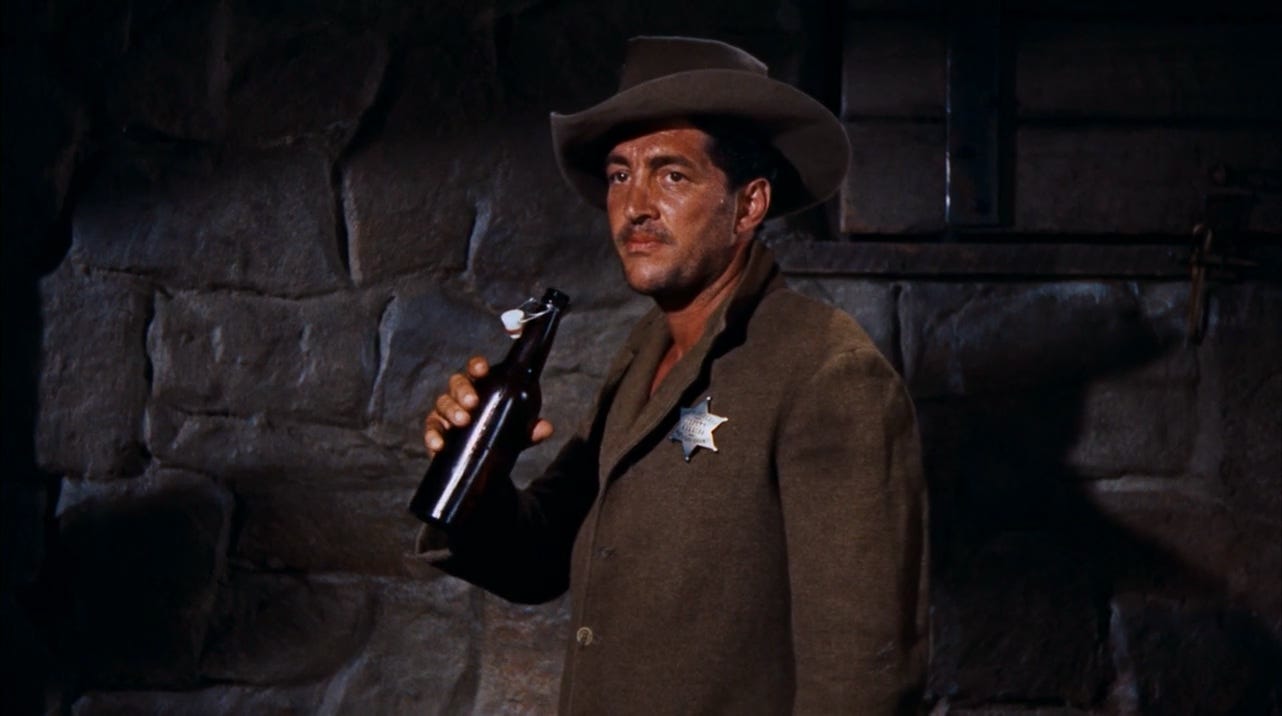
Dean Martin stole the show in a John Wayne Western.
Rio Bravo has an interesting place in the history of twentieth-century American cinema. As the story goes, Wayne was offered the starring role (which would eventually go to Gary Cooper) in High Noon, one of the most lauded Westerns of all time, but turned it down because he thought its message was un-American. Director Howard Hawkes and Wayne made Rio Bravo as a direct response to High Noon.
The parallels between the two are several: Whereas Will Kane (Cooper’s character) spends a good portion of the film canvassing the town for volunteer deputies to fight the bad guys, John T. Chance (Wayne’s character) is inclined to face the fight alone because he knows anyone who helps him will be endangered. While the townspeople of High Noon are by and large cowardly, there are several helpful folks in Rio Bravo who want to do the right thing. Kane has a Mexican ex-lover who leaves town via train; Chance has a Mexican friend who is in the thick of the action and even picks up a gun and starts shooting at the end. The only likely candidates to help Kane are his former mentor, who by this point is too old and crippled to be of any help; a kid who Kane rejects for being too young; and a man named Herb Baker who does volunteer but backs out at the last minute when he realizes he’s the only one who did so. In Rio Bravo Chance has three deputies assisting him: an old cripple called Stumpy; a “kid” called Colorado; and his former deputy (played by Martin) called Dude who volunteers, eventually backs out, but takes heroic action towards the end to help save the day.
Ironically vis-a-vis Wayne’s self-crafted image as a rugged individualist, he and Hawks took issue with the idea in High Noon that the hero would be left to fight the fight alone. Additionally, High Noon’s scriptwriter Carl Foreman apparently intended it as an allegory for McCarthyism, which Wayne actively supported—indeed, Foreman himself ended up being blacklisted from Hollywood. However, political drama aside, both films are excellent artistic works in their own right. High Noon is correct that sometimes it really does come down to one man standing alone, while Rio Bravo is correct that human nature is fundamentally good and that heroism often comes from unexpected places.
No place is more unexpected than Martin’s character Dude. What elevates Rio Bravo from simply being a very good Western to being a masterwork is Martin’s performance. The tormented, alcoholic Dude is the hinge upon which depends the success or failure of Chance’s efforts. His struggle is a dramatization of the central question of the film: Is life a cynical but gripping drama in the manner of High Noon, or is it a fairy tale? It is also, I wager, one of the most poignant depictions of struggle with addiction ever shown on film. Cast against the backdrop of the political drama unfolding in Hollywood at the time, Dude’s alcoholism also offers a valuable lesson in what heroism might look like in the modern age, when so many of us are plagued by addictions of one kind or another. Whether or not the good guys win depends on whether or not Dude can overcome his drinking problem.
When we first meet Dude he is being tormented by a group of cruel men at a bar before the sheriff Chance rescues him. We shortly learn that he used to be Chance’s right-hand man before he fell in love with a woman passing through town on a train, the resultant romance ended in disaster, and he was driven to drink. Once a respected lawman, he is now known only as the town drunk.
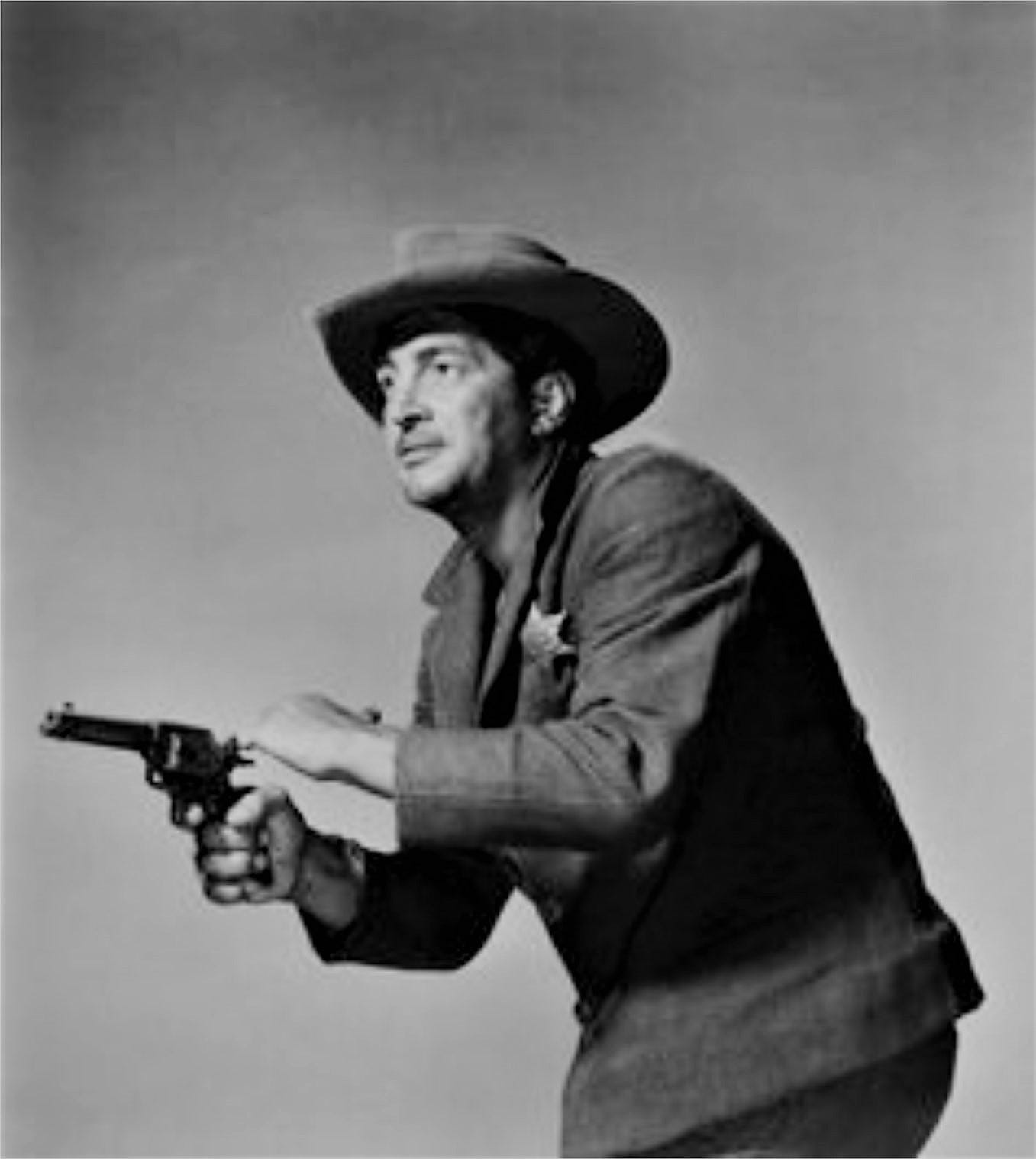
Dude’s first taste of redemption comes right away, as he helps Chance apprehend a murderer in a sudden display of his old mastery. The murderer, however, was a hired man, and Dude’s true test begins when Chance arrests the one who did the hiring. The crook’s brother is a wealthy but lawless rancher named Nathan Burdette, and when Burdette comes to town with his men to spring his brother from jail and take revenge on Chance, Chance must hold down the fort with the help of Dude and his other allies until U.S. Marshals arrive.
While Dude has been suddenly removed from the bar, the bar has not as it were been removed from Dude. He vows to forsake alcohol as he resumes his old role of deputy, but of course he desperately craves a drink. Things come to a head when he has a sleepless night filled with withdrawal tremors; caves; and has a beer. The following morning he has an argument with Chance before going on guard duty, but he is in such a bad state that he lets his guard down. The rancher’s men ambush and capture him with the intention of holding him for ransom, and it is only decisive action from Colorado that saves Dude. Full of shame and despair, he bows out of the operation.
The clip is about ten minutes long, but it’s worth watching in its entirety:
Doesn’t addiction do that to you? You try to turn your life around and think you’re doing pretty good, but one little relapse happens, everything crashes down, and all of a sudden you’re telling yourself that you’re a hopeless case and there’s no point in even trying.
But that isn’t the end of the story for Dude. Burdette has hired a Mariachi band to play “El Degüello,” a Mexican army song that indicates no mercy will be shown. After almost sinking back entirely into his old life, hearing the strains of El Degüello is enough to snap Dude out of it once and for all:
I submit that the best pop culture comparison to this moment is the climax of The Lord of the Rings. People’s (especially Gollum’s and Boromir’s) lust for the Ring, which is itself an embodiment of sin, is a perfect representation of addiction. Inside Mount Doom, Frodo ultimately decides to keep the Ring for himself. He has failed in his quest, and only Gollum jumping on him out of nowhere makes the Ring fall into the fires and be destroyed. Similarly, Dude tries but fails to rid himself of his alcoholism and fully intends to return to his life of despair. It is only El Degüello, coming through the window like a clarion call from Heaven (or like Gollum leaping onto Frodo’s back) that saved him. Both Frodo and Dude needed divine intervention.
Westerns have a mythic appeal to the American psyche. The Wild West was the last moment in our nation’s history when there were truly unexplored frontiers within our borders, and Westerns dramatized the fleeting period when America stretched all the way westward across the continent but the west itself was still wide open. The open plains in Westerns are like the forest in Grimm’s fairy tales—full of danger and treasures—and the small towns threatened by bandits are like little villages of yore threatened by monsters and witches. I expect that part of Hawk’s and Wayne’s objection to High Noon, though they might not have put it this way, is that it destroys the fairy tale-like feeling that is the core of the Western genre. It’s analogous to the “gritty reality” of Daniel Craig’s James Bond subverting the suave, alluring fun of Sean Connery’s.
Burdette is a genuine villain, while Chance and the rest of his friends are genuine heroes. Only Dude, sunk in his addiction, wouldn’t have a place in a fairy story cast of characters. He has lost his innocence, even were it the “innocence” of a pure villain. It is only with unbearable distress, unaccountably redeemed by the mariachi band, that Dude is at last able to be a man and a true hero. Rio Bravo seems to be saying that yes, reality becomes gritty and awful when we fall into sin, but by Jove, redemption and heroism are possible—indeed, are the higher reality!
Addiction plagues our society today, whether it be in the form of alcohol, drugs, or the multifarious, extremely common screen-based addictions that the internet, computers, and smartphones have brought about. Rio Bravo shows us that no matter what our circumstances may be, we all still have jobs to do, and if we are willing to endure suffering then we too may be redeemed.